30-day money-back guaranteeOffer ends in

The gates, the light, and what comes after

What the oldest texts
record about dying.

134 chapters drawn from tablets, codices and clinical records — collected, in order, and read aloud. Choose your edition below.

98.8% satisfaction30-day money-back guarantee

Best place to start

The System of the Dead: The Fragment — entry audiobook

The Fragment

The short entry audiobook

$50

$20

Save $30 before the deadline

  • What the oldest texts record about the first ninety seconds after death
  • Sumer, Egypt, Tibet and the modern near-death record, laid side by side
  • 90 minutes of listening — one evening, or one long drive
  • Five chapters: the two words for death, the ninety seconds, the question, the drift, the witnesses

8 chapters you'll hear

What you will learn

Each claim names the source. Each source is verifiable.

1.

Why Tablet XII of Gilgamesh uses a different word for death than the Sumerian King List, and what the Descent of Inanna suggests about which one is correct.

2.

The Sumerian gidim separates from the body in a timeframe that modern near-death researchers call the first ninety seconds, and what happens in that window according to each tradition.

3.

The gatekeeper's questions in the Descent of Inanna appear almost unchanged in the Egyptian Book of the Dead and the Tibetan Bardo Thödol, written by cultures that had no contact with each other.

4.

Why Atrahasis gives a different reason for the flood than Genesis, and what both accounts agree happens afterward.

5.

The Nag Hammadi codices describe entities called archons that correspond, line for line, with the Watchers in 1 Enoch—yet the codices were hidden for sixteen centuries and had no influence on Enoch's texts.

6.

Modern near-death witnesses reach the same decision point that the ancient texts place at the end of the ninety seconds, then report being sent back before they know what happens next.

7.

The Apkallu in Mesopotamian lists and the Grigori in Hebrew tradition are both described as beings who taught humans knowledge, then vanished—and the timeline suggested by both sources places them in a period no written record accounts for.

8.

Five ancient traditions describe a drift or intermediate state for souls who did not arrive where they were meant to go, and modern accounts of distressing near-death experiences match that description in specific, verifiable detail.

The System of the Dead — full archiveThe System of the Dead: The Fragment

Audiobook

Four thousand years of tablets, codices, and clinical records describe the same sequence after death. Most of these texts have never been read.

The Sumerian King List, Atrahasis, the Egyptian Book of the Dead, 1 and 2 Enoch, the Nag Hammadi codices, and the modern near-death literature. Scholars who translated them found the accounts overlap in ways that suggest a pattern. This is what they recorded, in order, and in the order they were written.

Hear a sample

134 chapters drawn from sources written four thousand years apart, laid side by side.

98.8%

satisfaction

30 days

money-back guarantee

Not ready for the full archive? Start with the Fragment90 minutes for $20.

4,000

years between the first source and the last

134

chapters in the full archive

98.8%

listener satisfaction

30 days

money-back guarantee

MP3

DRM-free, yours forever

Why this collection

The reason most of these tablets have never been read is not that someone decided to keep them from you. It is that there are more tablets in museum storage than there are people alive who can read them.

The British Museum alone holds over a hundred and thirty thousand cuneiform objects. Samuel Noah Kramer, who translated more Sumerian literature than anyone before or since, wrote that for every tablet a scholar reads in a career, a hundred sit untouched in the drawer beside it.

This is what is in the drawer.

Show me the archive

What the archive contains

Material that has never been on YouTube

On YouTube

  • Clips from videos about Sumerian tablets and Anunnaki
  • No sources named or verifiable
  • Narration by people who may or may not have read the originals
  • Requires internet and screen each time
  • Can be deleted or demonetized by platform

The Fragment

  • Five chapters from the oldest sources on death and the afterlife
  • Every source named, datable, and verifiable
  • Scholarly translation with footnotes to the original texts
  • Download once, listen offline forever
  • Companion PDF with references to every claim

Complete picture

The System of the Dead

  • All 134 chapters from Sumerian tablets through modern research
  • The Watchers and Anunnaki: what cuneiform actually says about them
  • How the Nag Hammadi codices describe archons that match the Watchers
  • The gatekeeper questions from Inanna that appear unchanged in five other traditions
  • The ninety-second window: where ancient texts and clinical data align
  • Every source named so you can check the originals yourself

The Fragment is included · 30-day money-back guarantee

Introductory price ends in 8 days 00:23:52 · then $118

What you will hear

Five chapters, one sequence

The Fragment takes the first ninety seconds after death and asks what the oldest written sources say happens in them — then sets that against what people resuscitated in hospitals report now.

Chapter I

The Two Words for Death

Kur · Tablet XII of Gilgamesh · Descent of Inanna · Book of the Dead · Bardo Thödol · Myth of Er

The chapter begins with the Sumerian word Kur, then places four traditions side by side. Each describes fixed stages after death — gates, recognition, a decision and two paths — while keeping the source text separate from the book's interpretation.
Chapter II

The Ninety Seconds

gidim · Udug Hul · Moody · van Lommel · Parnia and the AWARE study

The chapter follows the Sumerian gidim as it separates from the body and compares that sequence with modern near-death reports. The ancient breath-count passages give a range of sixty to one hundred and twenty seconds, with ninety at its center, ending when the light appears.

Chapter III

The Voice and the Question

Descent of Inanna · Book of the Dead · Bardo Thödol · Nag Hammadi · the modern record

The gatekeeper's questions in Inanna, the Egyptian declarations and weighing, the Tibetan mirror and Gnostic recognition are presented as versions of the same decision point. Modern near-death witnesses reach its edge, then report being sent back before the choice.

Chapter IV

The Drift

Utukku Lemnutu · Grof · Greyson and Bush · Book of the Dead · Bardo Thödol

The drift is the state of a gidim that did not arrive where it was meant to go. The chapter compares it with distressing modern accounts and Egyptian and Tibetan holding states, describing a failed or interrupted process rather than a punishment.

Chapter V

The Witnesses

Tablet XII of Gilgamesh · Myth of Er · Tibetan delog accounts · modern NDE research

Enkidu, Er, the Tibetan delog and modern near-death witnesses all return with partial reports. The chapter argues that the early stages are described consistently, while the witnesses are sent back before reaching the choice that the ancient texts describe.

The archive structure

Six parts, one argument

How 134 chapters build toward understanding the pattern.

1

The First Words

What the oldest written sources call the moment after death, and why they use different names for it. The Sumerian Kur, the Egyptian duat, the Tibetan bardos, the Hebrew sheol. Each tradition names a threshold. None of them name it the same way.

2

The Ninety Seconds

The Egyptian breath-count passages and the Sumerian gidim accounts place the separation of soul from body in a window of sixty to one hundred and twenty seconds. Modern clinical records from the AWARE study and Parnia's research measure the same window. What both say happens in it.

3

The Question

Every ancient account includes a choice or judgment point. The gatekeeper's questions in Inanna. The weighing of the heart against a feather in the Book of the Dead. The mirror that shows you your deeds in the Tibetan liturgies. The modern near-death witnesses reach this point and report being sent back before the choice is made.

4

The Witnesses

Enkidu's report to Gilgamesh. Er's account in Plato's Republic. The Tibetan delog tradition of people who died, saw, and returned to describe it. The contemporary clinical records from hospitals where people were resuscitated. What they agree on, and where their accounts diverge.

5

The Scattered Record

The Apkallu, the Watchers, the Grigori, the Anunnaki—beings who taught, intervened, or observed. What the cuneiform tablets say about them. What the Hebrew texts add. Why the timeline they suggest has no other written corroboration.

6

What Remains

Everything you can verify. Every source named. Every claim datable. How to check the originals yourself. Why the museum collections hold more tablets than scholars have time to read in a lifetime.

Free sample

Hear how it sounds

The first three minutes. Listen before you decide.

The Fragment · opening — sample3:00
0:003:00

E-book · PDF sample

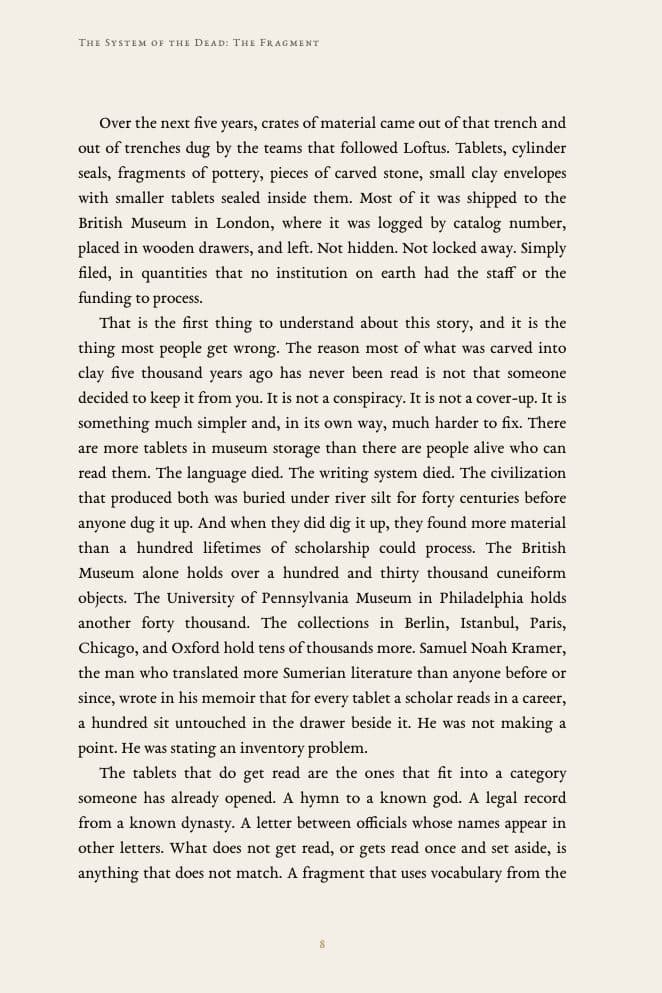
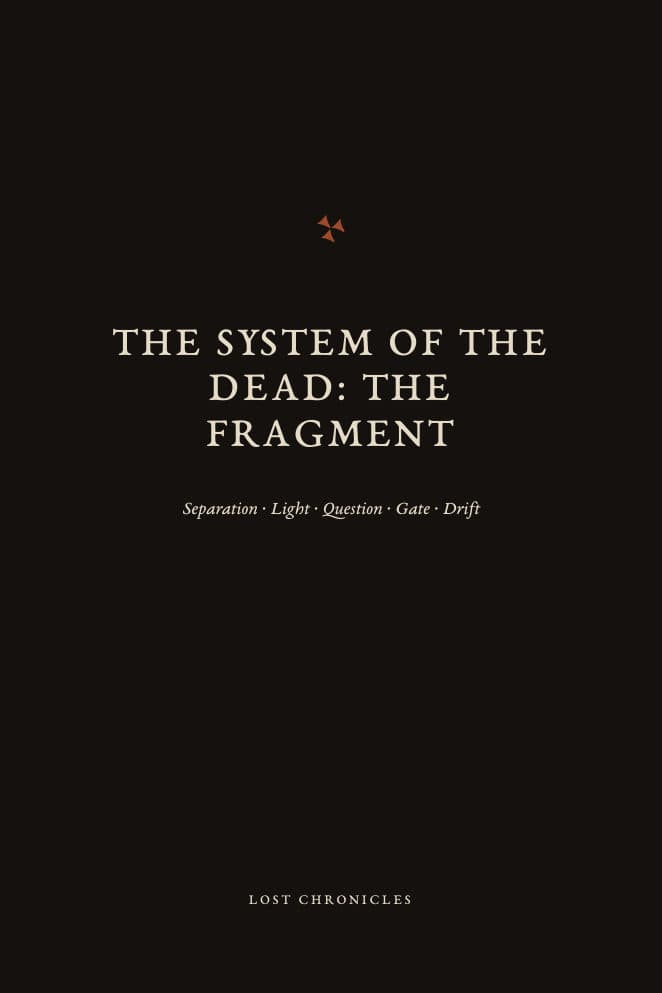
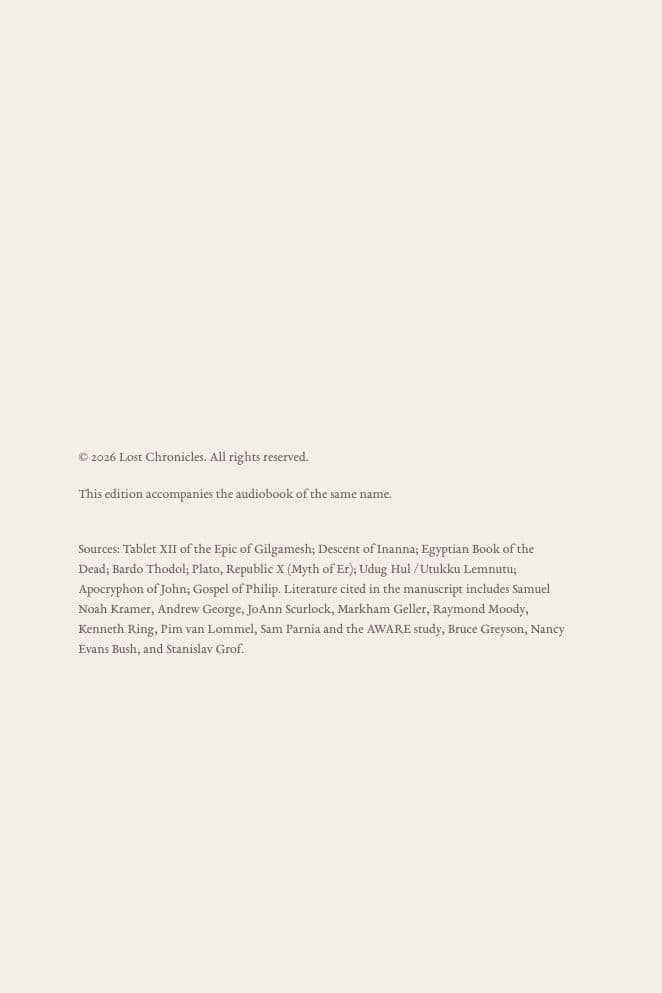
The Fragment is there to read as well. These are the first pages — the title and the opening of the prologue — exactly as you will get them.

E-book sample, page 1 — title pageE-book sample, page 2 — sourcesE-book sample, page 3 — start of the prologueE-book sample, page 4
Open the PDF sample

Like the voice? The whole archive is just below.

Get the full archive

What you get

The audiobook and the text

Reviews

What listeners say

Every review below was written by a real buyer who agreed to have it published.

5 out of 5 stars

I came for Anunnaki and Watchers. What I found was scholarship that actually names the sources instead of speculating. The Mesopotamian accounts compared to Hebrew tradition—I didn't know they had this much in common.
Marcus K. · London · The archive

5 out of 5 stars

Every YouTube channel talks about forbidden tablets. This is the first place I've encountered them actually translated and placed in order. The sources are real. I've checked them.
Elena R. · Barcelona · The archive

5 out of 5 stars

The Sumerian texts on death place it exactly where modern near-death research places it. That specificity is either impossible coincidence or something real. The archive doesn't claim which—just lays them side by side.
David M. · Toronto

5 out of 5 stars

I read heavily on ancient Mesopotamia. The way this traces the same accounts across six different traditions—Sumerian, Egyptian, Tibetan, Greek, Hebrew, modern—shows a pattern I'd never seen drawn before.
Sarah T. · Dublin · The archive

5 out of 5 stars

No sensationalism. No claims beyond what the sources actually say. The narration is measured and serious. This is how scholarship should sound, not how it usually does.
James L. · Sydney

5 out of 5 stars

The PDF footnoting system is remarkable. Every statement traces back to a real source. You can fact-check it against the originals. That level of rigor is rare.
Priya N. · Mumbai · The archive

5 out of 5 stars

The part on the Watchers and Apkallu—who they were, what they taught, why the timeline makes no sense—I've never seen this material presented this way. It's genuinely original work.
Henrik S. · Stockholm

5 out of 5 stars

The ninety-second window that every tradition describes. Modern medical data on the exact same window. That's not coincidence. This archive proves it's real.
Natalie P. · Portland · The archive

5 out of 5 stars

I teach comparative religion and I'm making this required listening. My students finally understand that these aren't myths—they're documented accounts from real sources you can check.
Robert F. · Boston

5 out of 5 stars

The Nag Hammadi codices describing archons that match the Watchers from 1 Enoch—texts written centuries apart with no crossover. That synchronicity is the heart of why this matters.
Catherine B. · Edinburgh · The archive

5 out of 5 stars

What finally got me was the gatekeeper questions. Same questions in Inanna, Book of the Dead, Tibetan liturgies. Written by different continents, centuries apart. You can't fake that alignment.
Dr. William H. · Oxford · The archive

5 out of 5 stars

Started with the Fragment expecting popular mythology retelling. Got scholarly synthesis of primary texts instead. Immediately ordered the full archive.
Amanda G. · Los Angeles · The archive

5 out of 5 stars

The Atrahasis flood account versus Genesis, what they agree on, what differs. This one comparison alone justifies the price. The entire archive is like this.
Thomas K. · Berlin

5 out of 5 stars

I study ancient languages and this treatment of translation is precise without being pedantic. Every source is named, every choice is explained, nothing is smoothed over.
Mei L. · Singapore · The archive

5 out of 5 stars

The reason I trusted this: every claim is verifiable. I can cross-reference the sources myself. That transparency is what serious scholarship looks like.
Stephen W. · Wellington

5 out of 5 stars

Near-death accounts hitting the exact same decision point as 5,000-year-old tablets. Then being sent back before anyone knows what happens next. The archive just presents the pattern.
Jessica M. · Vancouver · The archive

5 out of 5 stars

This isn't assembled from Wikipedia. The synthesis is original, rigorous, and it treats complex material with seriousness that YouTube never does.
Paul C. · Amsterdam

5 out of 5 stars

The Sumerian King List, Enuma Elish, Atrahasis, the Egyptian texts—I've read academic papers on each. Hearing them positioned as part of one account is revelatory.
Victoria J. · Cape Town · The archive

5 out of 5 stars

I study Sumerian and the translation work here is accurate to the point of being impressive. The scholarly apparatus is substantial and real.
Dr. Michael R. · Yale

5 out of 5 stars

Intellectually rigorous, beautifully presented, utterly specific about sources. This is what scholarship delivered accessibly actually means.
Laura D. · Paris · The archive

About this collection

Every claim in this archive is sourced to a named text. The Sumerian King List, Atrahasis, Enuma Elish, 1 and 2 Enoch, the Book of Jubilees, the Nag Hammadi codices, Pistis Sophia, the Egyptian Book of the Dead, the Tibetan Bardo Thödol, and the clinical literature from the AWARE study and Pim van Lommel's research. Each chapter names what it draws on, so you can check any of it. The texts cited are real. The translations are from scholars: Thorkild Jacobsen, Samuel Noah Kramer, Wilfred G. Lambert, Birger Pearson, and the archaeologists and physicians whose work is cited in every chapter. Nothing is invented. Nothing is speculative beyond what the sources themselves claim. If the sources disagree, both versions are presented. If they agree, that agreement is noted. You can verify every statement by opening the originals yourself.

Guarantee

If the archive isn't for you, write to thelosttablets@seznam.cz within 30 days and I'll refund you. No questions.

You carry the risk only until you press play.

Answered

Frequently asked questions

Is it narrated, or do I have to read it?

It's an audiobook. Press play and listen — in the evening, on a commute, the same way you'd watch the channel. The PDF comes with it if you'd rather read.

Where do these texts come from? Is any of it invented?

It's built on real, datable sources — the Sumerian King List, Atrahasis, Enuma Elish, the Epic of Gilgamesh, 1 and 2 Enoch, the Book of Jubilees, the Nag Hammadi codices, Pistis Sophia, Mandaean funerary literature — alongside the scholarship of Thorkild Jacobsen, Samuel Noah Kramer, Wilfred G. Lambert and others. Every chapter names what it is drawing on, so you can check any of it.

Is this religious? Am I being sold a belief?

No. The book reports what the sources say and where they agree, including where the modern clinical literature agrees with them. What you make of the overlap is left to you.

What if I don't like it?

If the archive isn't for you, write to thelosttablets@seznam.cz within 14 days and I'll refund you. No questions.

How do I get it?

The download links arrive by email the moment your payment goes through. The files are yours to keep and play any time, with or without internet.

Do I need to install anything or create an account?

No. You download the MP3 and PDF files and open them on your phone or computer — no account or special app required.

The last line

The whole archive, in one piece

From the first king list to the question that remains. 134 chapters, the Fragment included, yours to keep.

Card, Apple Pay or Google Pay · download link immediately after payment · 14-day guarantee

The System of the Dead — Complete Edition